Chapter: Chemical Bonding· Chemistry
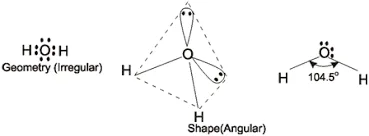
Answer: Oxygen in H2O has 2 bond pairs and 2 lone pairs (tetrahedral electron-pair arrangement); the molecule is angular (bent / V-shaped) with H–O–H bond angle 104.5°.
Electron distribution around oxygen:
- Electronic configuration of O (Z = 8): 1s2 2s2 2p4. It has 6 valence electrons.
- Oxygen shares one electron with each of the two H atoms, forming two O–H single bonds (2 bond pairs).
- The remaining 4 valence electrons stay on oxygen as 2 lone pairs. Thus oxygen has 4 electron pairs (8 electrons) around it, i.e. a complete octet.
- Lewis structure: H : Ö : H, i.e. H–O–H with two lone pairs (four dots) on the oxygen atom.
Shape:
- Oxygen is sp3 hybridized; the four electron pairs point towards the corners of a tetrahedron (electron-pair geometry is tetrahedral).
- Only two corners are occupied by H atoms; the other two are lone pairs. Lone pair–lone pair repulsion > lone pair–bond pair > bond pair–bond pair repulsion, so the O–H bonds are pushed closer.
- Hence the shape of the water molecule is angular (bent or V-shaped), not tetrahedral.
H–O–H bond angle: 104.5° (less than the tetrahedral angle 109.5° because of the two lone pairs).